
Getting a website published is only the first step. The harder part is helping the right people find it. Search engine optimization involves keyword research, competitor analysis, technical checks, content optimization, internal linking, and ongoing monitoring. Doing all of that manually can take considerable time, especially for a small team.
AI has changed how many SEO platforms approach these tasks. Modern tools can analyze search results, identify content gaps, suggest improvements, monitor rankings, and increasingly track how brands appear in AI search results. That does not remove the need for an SEO strategy, but it can make the research and optimization process easier to manage.
In this blog, we look at four of the Best AI Tools To Buy for SEO: Surfer, Semrush, Ahrefs, and Frase. Each takes a different approach, so the right choice depends on whether your priority is content optimization, competitor research, technical SEO, backlinks, or AI search visibility.
Surfer
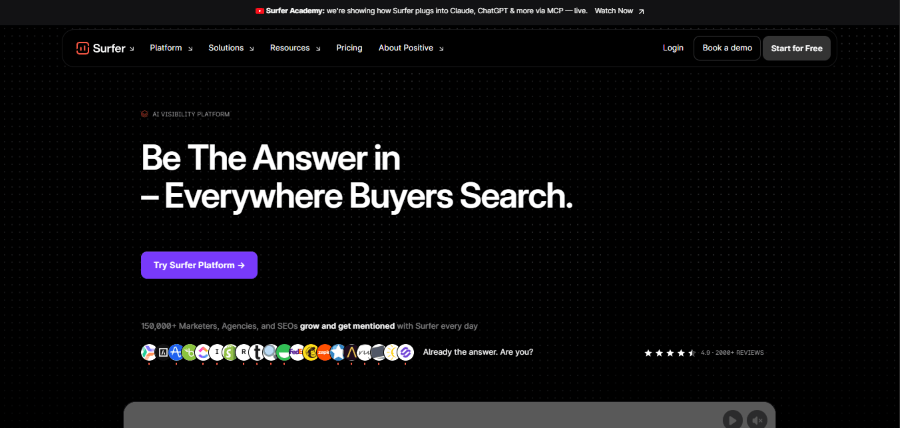
Surfer is an SEO and content optimization platform built around the idea of helping websites create content that is competitive in search. Its Content Editor analyzes search results and provides recommendations that writers can use while creating or improving an article.
The platform has also expanded beyond traditional content optimization. Its current toolkit includes AI Tracker for monitoring visibility in AI answers, Content Audit for finding opportunities on existing pages, and Topical Map for identifying content opportunities. Surfer describes this as a workflow that moves from research and planning into content creation, optimization, and AI visibility monitoring.
For a website owner, this can be useful when content already exists but is not performing as expected. Instead of guessing whether an article needs more depth, better structure, or stronger topical coverage, Surfer provides data-driven recommendations to guide the work.
Key Features
- Content Editor: Optimize articles around the topics and terms found in competing search results.
- AI Tracker: Monitor how a website or brand appears in AI-generated answers.
- Content Audit: Find optimization opportunities across existing website content.
- Topical Map: Discover related topics and build a more organized content strategy.
- Keyword Research: Find keyword opportunities for content planning.
- Content Planner: Organize content ideas around topical relevance.
- Content Score: Evaluate how well content covers the subjects associated with a target query.
- AI Content: Generate content with Surfer’s AI writing capabilities.
- Internal Linking: Identify opportunities to connect related pages.
- SERP Analysis: Examine the search results and competing pages before creating content.
Surfer Pricing
Surfer’s pricing can vary depending on the toolkit and current promotional offers. The company currently promotes its SEO toolkit around content optimization, AI search visibility, content auditing, and related workflows.
- AI Search Analytics: $82 per month
- Standard: $99 per month
- Pro: $182 per month
- Peace of Mind: $299 per month
Pros and Cons
Pros
- Strong focus on content optimization.
- Combines traditional SEO with AI visibility features.
- Content Audit can help improve older pages.
- Topical Map can assist with content planning.
- Useful for teams producing SEO-focused content.
Cons
- The number of available features can make the platform feel complex to beginners.
- It is primarily valuable to websites that actively publish and optimize content.
- Advanced usage can require a higher-priced plan.
For Whom Surfer Is Built For
Surfer is built for bloggers, publishers, SEO professionals, affiliate websites, agencies, and businesses that rely on organic traffic.
If a business publishes articles without reviewing how those pages compare with competing results, it may spend time creating content that does not address the searcher’s needs as well as it could. Surfer provides a structured way to analyze and improve that content.
Semrush
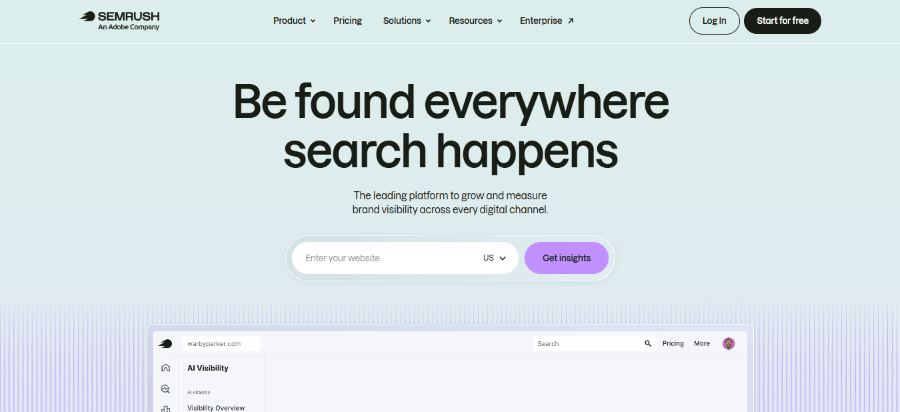
Semrush is one of the broadest tools in this category. Rather than focusing on one SEO task, it combines keyword research, competitor analysis, site auditing, position tracking, content optimization, and AI search visibility.
Its current SEO and AI Search plans also include features designed specifically for monitoring how domains and brands appear in AI search. The platform lists AI visibility reports, AI sentiment monitoring, custom prompt tracking, and AI-ready site audits among its current features.
That makes Semrush particularly useful for businesses that want one platform for a large part of their search strategy. A website owner can research competitors, find keywords, audit the site, track rankings, and monitor newer AI search visibility from the same ecosystem.
Semrush is also moving further into brand visibility. Its current platform describes itself as covering AI search, SEO, PPC, social, and other areas rather than operating as a traditional keyword research tool alone.
Key Features
- Keyword Research: Find keywords and evaluate their search potential.
- Keyword Strategy: Organize keyword opportunities into broader SEO plans.
- Competitor Research: Analyze competing websites and their search visibility.
- Position Tracking: Monitor keyword rankings over time.
- Site Audit: Identify technical and SEO issues affecting a website.
- On-Page SEO: Get recommendations for improving individual pages.
- AI Search Visibility: Track how a brand appears across AI search platforms.
- AI Visibility Reports: Examine AI visibility for domains.
- AI Sentiment: Monitor how AI systems describe a brand.
- Custom Prompt Tracking: Track selected prompts to understand AI search visibility.
- Content Tools: Create and optimize content around SEO requirements.
- Backlink Analysis: Research links pointing to websites and competitors.
Semrush Pricing
Semrush’s current SEO pricing starts with the SEO plan at $117.33 per month when billed annually, compared with $139 per month on monthly billing. It includes five websites to monitor, 500 keywords to track daily, keyword research, competitor analysis, position tracking, site audit, and AI search features.
For users specifically interested in the combined SEO and AI Search offering, Semrush currently lists:
- Starter: $199 per month
- Pro+: $299 per month
- Advanced: $549 per month
The higher plan expands website monitoring, keyword tracking, historical SEO data, and AI visibility capabilities.
Semrush also provides separate toolkits and add-ons, so the final cost can depend on which areas a business chooses to use.
Pros and Cons
Pros
- Very broad SEO feature set.
- Strong competitor research capabilities.
- Includes technical SEO and position tracking.
- Offers AI search visibility features.
- Useful for agencies managing multiple SEO projects.
Cons
- More expensive than specialized entry-level SEO tools.
- The platform can be overwhelming for a beginner.
- Some advanced features require additional plans or add-ons.
For Whom Semrush Is Built For
Semrush is best suited to businesses, agencies, SEO professionals, publishers, and marketing teams that need a broad SEO platform.
For a small website that only needs occasional keyword research, Semrush may be more than necessary. But for a business that needs to research competitors, audit websites, track rankings, analyze keywords, and monitor AI search visibility, having those functions in one platform can reduce the need for several separate subscriptions.
Ahrefs
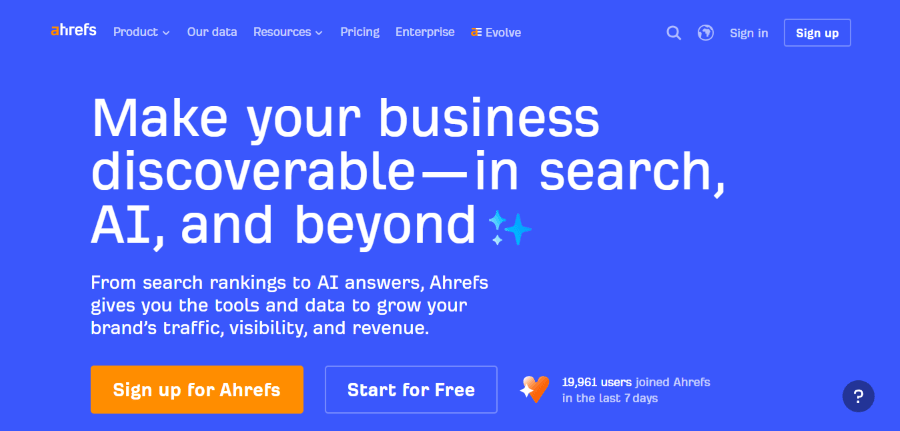
Ahrefs has long been known for its search and backlink data, but its current platform has expanded considerably into AI-powered SEO and marketing workflows.
The platform now describes itself as an AI marketing platform covering AI search, SEO, content, and social. Its current features include AI search visibility tracking, AI-assisted content creation, AI localization, AI content detection, and technical SEO tools.
The core value remains its large search database. For website owners, that means Ahrefs can be used to research keywords, examine competitors, investigate backlinks, audit websites, and identify content opportunities. The newer AI features add another layer to that research rather than replacing the underlying SEO data.
Ahrefs is particularly interesting for people who want to understand both traditional search visibility and how a brand is being represented in AI search.
Key Features
- Site Explorer: Research organic search traffic, keywords, and competitors.
- Keywords Explorer: Research keywords and evaluate search opportunities.
- Site Audit: Find technical and on-page SEO issues.
- Rank Tracker: Monitor search rankings over time.
- Content Explorer: Discover popular content and research content opportunities.
- Backlink Analysis: Examine backlink profiles and link opportunities.
- AI Search Visibility: Track brand visibility across AI search.
- Custom Prompts: Monitor brand performance for selected AI search prompts.
- AI Content: Help create content designed to perform in search and AI environments.
- AI Content Detector: Identify AI-generated content.
- AI Localization: Adapt content for international markets.
- Technical SEO Fixes: Ahrefs offers tools designed to help deploy selected technical SEO changes without requiring developer involvement.
Ahrefs Pricing
Ahrefs currently offers a Starter plan at $29 per month. The paid plans then move to:
- Lite: $129 per month.
- Standard: $249 per month.
- Advanced: $449 per month.
- Enterprise: $1,490 per month.
Ahrefs states that annual billing is available for its paid plans other than Starter and can provide two free months.
Ahrefs also provides a free account with limited access to tools such as Site Explorer and Site Audit after a paid subscription ends.
Pros and Cons
Pros
- Strong search and backlink data.
- Excellent competitor research capabilities.
- Includes technical SEO tools.
- AI search visibility is now part of the platform.
- Several pricing levels are available.
Cons
- Higher plans can become expensive.
- The amount of data and features may be difficult for beginners to understand.
- The Starter plan is considerably more limited than the larger plans.
For Whom Ahrefs Is Built For
Ahrefs is built for SEO professionals, agencies, publishers, affiliate marketers, businesses, and website owners who want detailed search and competitor data.
If SEO decisions are being made mainly from guesswork, a platform like Ahrefs can provide a stronger research foundation. On the other hand, buying Ahrefs for a website that rarely publishes content or competes in search may not provide enough value to justify the subscription.
Frase
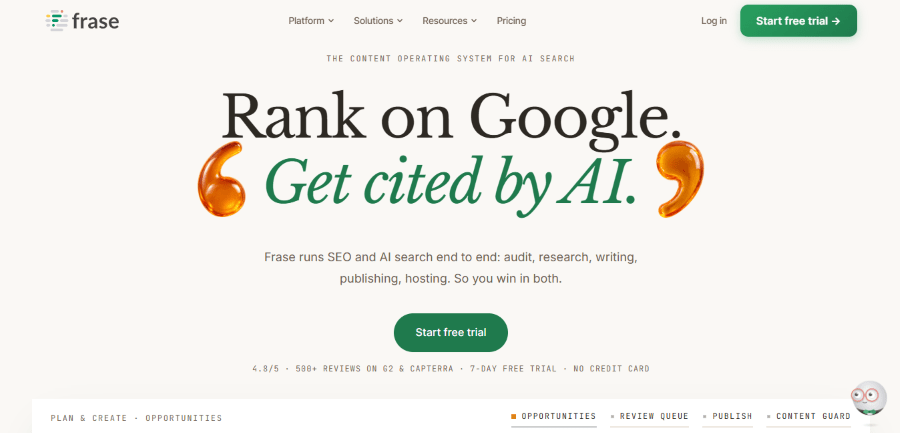
Frase takes a content-first approach to SEO. Rather than trying to be an all-purpose marketing suite, it focuses on helping teams research, write, optimize, audit, and monitor content.
Its current platform has also expanded into AI search visibility. Frase describes its workflow around research, optimization, publishing, monitoring, and fixing content. It also provides AI visibility and GEO features designed to help businesses understand how their content and entities appear in AI-generated search results.
This makes Frase an interesting option for websites where content is the center of the SEO strategy. A writer can research a topic, create an article, optimize it, and continue monitoring the page without moving through several unrelated tools.
Frase also provides AI writing capabilities that can learn a brand’s style from existing examples. Its AI article writer can use a brand voice so that generated drafts are closer to the company’s established writing style.
Key Features
- AI Article Writer: Create research-backed long-form content.
- Content Editor: Optimize articles against search competitors and topic coverage.
- SERP Research: Analyze search results before writing.
- Content Briefs: Build structured briefs around search intent and competing pages.
- Content Optimization: Improve existing articles based on SEO recommendations.
- Content Audit: Review website content and identify pages that need attention.
- Brand Voice: Train Frase on examples of existing writing.
- AI Visibility: Monitor how content and brands appear in AI search.
- GEO Scoring: Evaluate content for generative engine optimization.
- Content Watchdog: Monitor published content for changes and opportunities.
- Frase Agent: Connect research, optimization, monitoring, and content improvement into a more continuous workflow.
Frase Pricing
Frase currently lists three main self-serve plans:
- Starter: $49 per month.
- Professional: $129 per month.
- Scale: $299 per month.
Frase also offers a free trial and does not require a credit card for the trial, according to its current product information.
The plans increase the amount of content generation, SEO research, optimization, AI visibility, and other capabilities available to the user.
Pros and Cons
Pros
- Strong focus on content-led SEO.
- Combines research, writing, and optimization.
- Includes AI visibility features.
- Brand Voice can help maintain consistent writing.
- Self-serve pricing is clearly published.
Cons
- Less broad than an all-in-one SEO suite such as Semrush.
- Businesses needing extensive PPC, social, or large-scale competitor data may need another platform.
- Advanced capabilities require higher plans.
For Whom Frase Is Built For
Frase is built for bloggers, publishers, content teams, agencies, affiliate marketers, and businesses where organic traffic depends heavily on written content.
It can be particularly useful when the main SEO problem is not finding a keyword but turning that keyword into a useful, competitive article. Without a content-focused platform, writers may have to research competitors manually, prepare briefs separately, write the article in another application, and then check optimization elsewhere.
Which AI SEO Tool Should You Buy?
Each of these tools serves a slightly different purpose.
Surfer is a strong choice when content optimization is the main priority. It is particularly useful for improving existing articles and creating content around competitive search results.
Semrush is better suited to businesses that want a broad SEO and AI visibility platform covering keyword research, competitors, technical SEO, rankings, and search visibility.
Ahrefs is a strong option for users who place a high value on search, competitor, and backlink data while also wanting access to newer AI SEO features.
Frase is a good fit for content-focused teams that want research, writing, optimization, auditing, and AI visibility in one workflow.
The implications of not using an SEO platform depend on the size and goals of the website. A small site can certainly perform SEO work manually, but research becomes harder as the number of pages, competitors, keywords, and content projects increases. Without reliable data, it is easier to spend time optimizing the wrong pages or targeting topics that do not fit the business.
The best reason to invest in one of the Best AI Tools To Buy for SEO is therefore not to let AI run your entire search strategy. It is to give your team better information and reduce the manual work involved in researching, improving, and monitoring a website.
For a business that depends on organic traffic, that distinction matters. The tool should support the SEO strategy, not become the strategy itself.
